Draft survey step by step: from six draft readings to the cargo figure
How a draft survey works on a tanker or bulk carrier: reading six drafts, the quarter mean, trim and density corrections, deductibles and the constant.
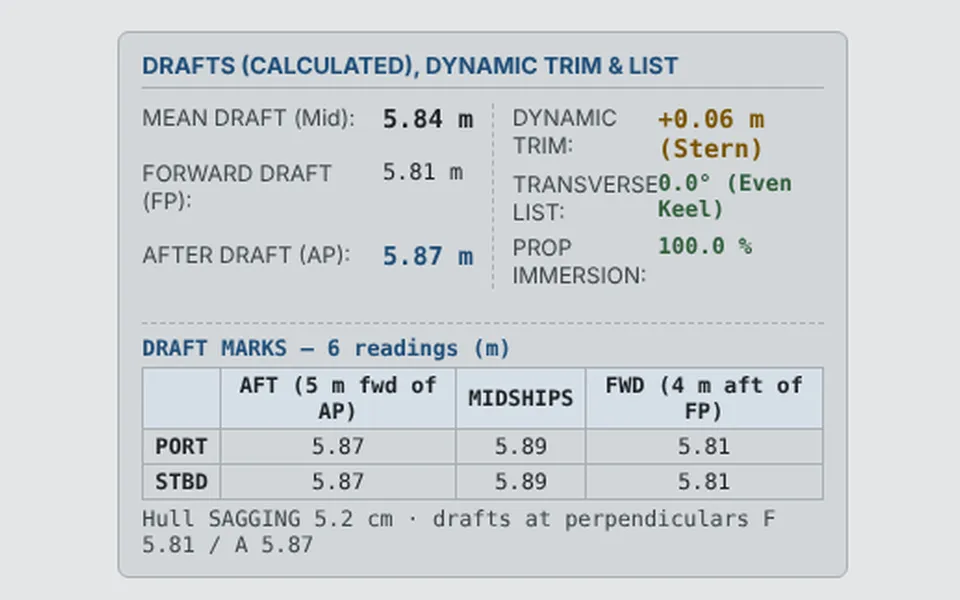
A draft survey works out the weight of cargo from how deep the ship floats. The ship's displacement is read from her drafts before and after loading or discharging. Take away everything that is not cargo, and the difference is the cargo. It is used for bulk cargoes and as a cross-check on liquid cargo figures, and it is a good test of how well an officer understands the hydrostatic tables.
1. Read six drafts
Read the forward, midship and aft draft marks on both sides: six readings. Port and starboard differ when the ship has a list, so take the mean of each pair. Read close to the waterline, from a launch or the quay, and average the waves over several swells. Slack water and a calm sea give the best result.
- Perpendicular corrections. The forward and aft marks are usually not at the perpendiculars. Correct each one using the trim and its distance from the perpendicular, so you have the true drafts at the forward and aft perpendiculars.
- Keel correction. Draft marks show the draft to the bottom of the keel. Hydrostatic tables are often given for the moulded draft, so check which one the tables use.
2. Allow for the hull bending
A loaded hull bends. When she sags, the midship draft is deeper than the mean of the forward and aft drafts; when she hogs, it is shallower. The quarter mean allows for this:
Quarter mean = (F + 6 × M + A) ÷ 8
Enter the hydrostatic table with the quarter mean to read the displacement, TPC, LCF and MTC.
3. Trim corrections
The table assumes the ship is on an even keel. When she is trimmed, the waterplane turns about the centre of flotation (LCF), not about midships, so two corrections are needed:
- First trim correction = trim (cm) × TPC × LCF from midships ÷ LBP. It is added when the LCF is on the same side of midships as the deeper end, and taken off when it is not.
- Second trim correction = 50 × trim (m)² × (MTC at quarter mean + 0.5 m − MTC at quarter mean − 0.5 m) ÷ LBP. It is always added.
4. Density correction
The table is for salt water, usually 1.025 t/m³. Take dock water samples at several depths along the ship's side, read the density with a hydrometer, and correct:
Corrected displacement = displacement × dock density ÷ table density
5. Deductibles and the constant
Take away everything on board that is not cargo: ballast (sound every tank and use the density of the ballast water), fuel oil, diesel oil, lubricating oil, fresh water and any other liquids. What is left after the lightship is the constant: stores, spares, crew and effects, and the small errors in the ship's data.
Cargo = net displacement at the final survey − net displacement at the initial survey. The constant cancels out, so it only has to stay the same between the two surveys. Never change it to make the figure agree with the bill of lading.
Common mistakes
- Reading the drafts with the ship still moving, or with ballast or bunkers still being transferred.
- Forgetting the list, or reading only one side.
- A slack ballast tank sounded with the wrong trim correction.
- One dock water sample from the surface only.
- Different tables, or a different constant, at the initial and final surveys.
In the M/T KEN VILLAMOR simulator the loading computer shows all six draft readings, port and starboard, with the list and the hull sagging or hogging from the bending moment. The hydrostatic table comes from the ship's own hull, and RIGEL can work through a full draft survey with the ship's real numbers, step by step.
Practise it in the simulator
Try this on the M/T KEN VILLAMOR tanker simulator, in your browser or on the Windows app.
Open the simulatorMore posts
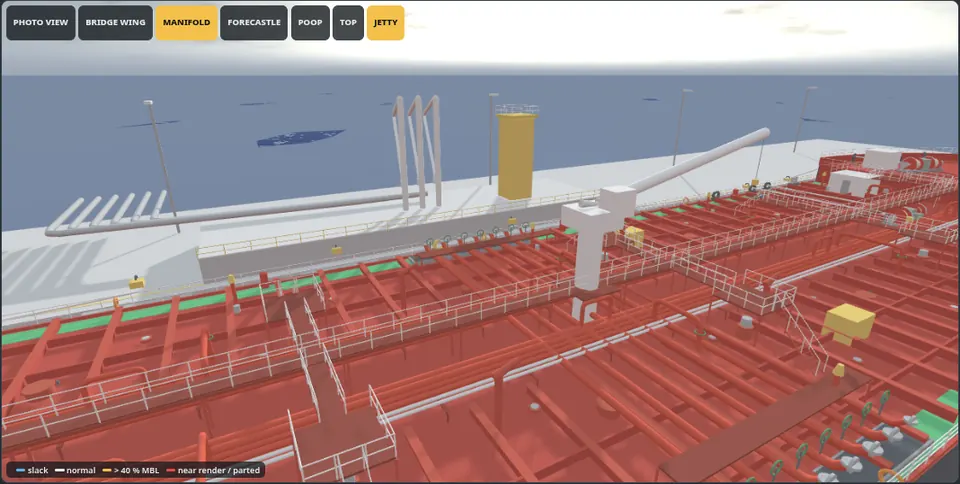
Cargo manifold checks before you open the first valve
A simple order of checks at the cargo manifold before loading or discharging: line-up, connection, drip trays, checklist, then a slow start.
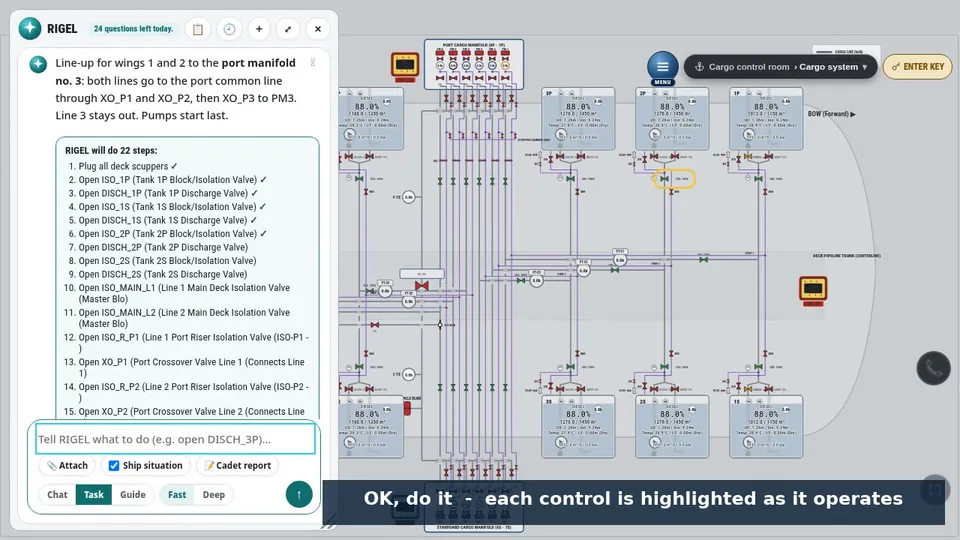
RIGEL: an instructor inside the simulator
Give RIGEL a task, let it teach you step by step, or ask it questions. How Task, Guide and Chat mode work in the M/T KEN VILLAMOR simulator.